
Montefiascone is not just a charming medieval hilltop town: it is a place where history has built up in layers, and where every corner seems to have something to tell… if you know where to look.
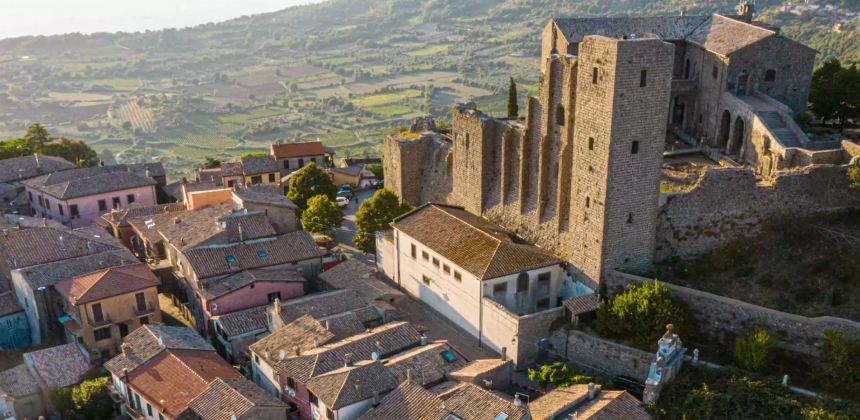
Located at around 600 meters above sea level, at the highest point of the volcanic crater of Lake Bolsena, this town held a key strategic position in central Italy for centuries. As early as the Middle Ages, it was part of the so-called “Patrimony of St. Peter,” and its importance grew particularly under the papacy of Innocent III (1198–1216), when the imposing Rocca dei Papi became one of the most significant fortresses in the Papal States.
For several centuries—at least until the 16th century—this fortress played not only a defensive role but also a political and symbolic one. Popes, emperors, nobles, and religious figures passed through its halls, turning it into a true center of power. Today, beyond its historical value, it remains the best viewpoint in the area: from here, visitors can admire Lake Bolsena, the surrounding volcanic hills, and on clear days even the distant outline of the Tyrrhenian Sea. Lake Bolsena is the largest volcanic lake in Europe.
Montefiascone’s religious significance is also reflected in the Cathedral of Santa Margherita, whose construction took place between the 15th and 16th centuries, during the consolidation of the local diocese promoted by Pope Urban V. The building, largely attributed to architect Michele Sammicheli, features a monumental structure crowned by a dome 27 meters in diameter, one of the largest in Italy. In 1943, Pope Pius XII granted it the title of minor basilica, further enhancing its importance.
But Montefiascone is not only about ecclesiastical history. Its winemaking tradition is just as ancient and renowned, especially for the famous Est! Est!! Est!!!, linked to a medieval legend that still forms part of the town’s identity today. Each year, this tradition is celebrated during the wine festival, which now boasts more than sixty years of history.
Unexpectedly, the town also intersects with universal culture. In 1697, Charles Perrault published his version of “Cinderella,” which later inspired composer Gioachino Rossini. His opera La Cenerentola, first performed in 1817 at the Teatro Valle, explicitly sets the story in the castle of Don Magnifico, Baron of Montefiascone. Since then, many have suggested that this castle may correspond to the Rocca dei Papi itself, adding an almost literary dimension to the town’s historic landscape.
Walking today through the historic center of Montefiascone—with its medieval streets, open squares, and noble buildings—means crossing centuries of history condensed into a relatively small space. Between architecture, religion, wine, and unexpected cultural references, the town offers a deeper experience than its size might suggest: not merely a stop along the way, but a place to pause and understand how history and territory intertwine.