
Borgo Pio, in the heart of Rome, is not just a picturesque street: it is a place where everyday life coexists — and sometimes is overwhelmed — by centuries of history. Long before it had this name, in ancient Roman times, the area was known as Ager Vaticanus, a land of monumental tombs. Here, in 135 AD, the mausoleum of Emperor Hadrian was built, now known as Castel Sant’Angelo.
In 848, the district became part of the Civitas Leonina, a fortified city protected by walls commissioned by Pope Leo IV. These defenses were connected to the famous Passetto di Borgo, an elevated passage that allowed popes to escape to the castle in times of danger.
For centuries, this area was a meeting point for pilgrims from all over Europe — Franks, Saxons, Lombards, and Germans — and from the latter comes the name “Borgo,” which in their language meant a “fortified settlement.” As early as 1300, Dante Alighieri mentioned in the Divine Comedy the crowds of faithful arriving for the first Jubilee, a tradition that continues today, when every 25 years the Vatican welcomes millions of pilgrims.
The neighborhood’s great development came during the Renaissance, driven by the powerful Medici family. It was in this context that Pope Pius IV gave Borgo Pio its name. In those days, these same streets were walked by artists such as Raphael, merchants, cardinals, papal doctors… and also courtesans, who were a common presence in Renaissance Roman society.
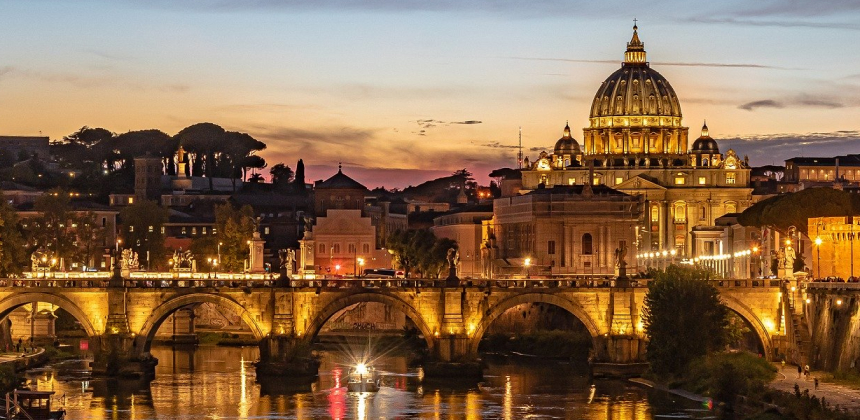
In 1586, Pope Sixtus V officially incorporated Borgo as Rome’s 14th district. A few decades later, in 1665, Gian Lorenzo Bernini completed the majestic colonnade of St. Peter’s Square, forever transforming the neighborhood’s appearance. Over time, the aristocracy moved away, and Borgo became home to artisans, clergy, and Vatican workers.
In 1870, with the unification of the Kingdom of Italy, the area experienced moments of tension: many residents wished to remain linked to the Vatican, but it ultimately became part of the new state.
Today, Borgo Pio is a vibrant pedestrian street, stretching about six blocks, full of color, low-rise buildings, and historic façades.
Vatican City, guarded by the Swiss Guard in their unmistakable uniforms. Along the street, you will find gelato shops, traditional restaurants, souvenir stores, and small businesses alongside long-standing bakeries and family-run shops managed by people from all over the world.
And in the middle of it all, your home for a few days. Because throughout the centuries, Borgo Pio has been much more than just a neighborhood: from the time of Pope Pius IV, when it was designed to welcome pilgrims, to today, it has hosted millions of travelers. Your apartment continues this tradition—offering hospitality in a place where history, beauty, and everyday life come together. Walking these streets is not just visiting Rome… it is becoming part of its story.